Sunday, November 11, 2012
Blavatsky in Hong Kong
A recent post at the blog The Dark World’s Fire: Tom and Lena Edgar in War is a good example of the sort of writing that only blogs can provide. Though somewhat afield of our subject (Mme. Blavatsky is mentioned), “Herbert Edward Lanepart (1): Theosophy in Old Hong Kong” opens up like never before the development of Theosophy in Hong Kong in the early part of the twentieth century. The account focuses on Herbert Edward Lanepart, who after being a devoted worker for Theosophy in Hong Kong, became a Nazi sympathizer. The author warns against jumping to unwarranted conclusions:
In fact, as every writer acknowledges, Nazism had many sources, and one of these was Christian anti-Semitism – even if, as Zygmunt Bauman has argued Nazi anti-Semitism is significantly different from ‘traditional’ European anti-Semitism it is impossible to imagine it coming in to being and so quickly taking hold of so much of German society without the ‘preparation’ of centuries of religious anti-Semitism (and those who like to point to Hitler’s interest in Blavatsky’s works might remember that Luther’s anti-Semitic ravings were amongst the most quoted ‘authorities’ in Nazi Germany). It would, of course, be obvious nonsense to suggest that someone became a Nazi because they had previously been a Christian.
When you see statements like: “The origin of Nazism can be traced back directly to Madame Blavatsky and her Theosophical Society,” you immediately know that the writer does not read German. The Nazis hardly had to go to Blavatsky for racial theories; there were more than enough home-grown sources.

Madame Blavatsky Reviewed
Reviews are starting to come in for Gary Lachman’s Madame Blavatsky: The Mother of Modern Spirituality. London’s Magonia Blog and Review of Books, which favors anomalous literature, carries a laudatory review. As an aside, it adds:
Not only does this landmark book rehabilitate the Madame herself, but it also casts a completely new light on her close associate Colonel Olcott, traditionally thought of little more than her dupe and lap dog. Yet consider this:
He was an astonishing healer, using the even then outmoded technique of making ‘passes’ with his hands over the sick, but it certainly worked. He cured at least 8000 Indians in a year, only stopping because the Masters told him to, as his own health was at risk. He devoted every ounce of his strength – and not just psychically - on behalf of the people he lived among, and in 1967 Sri Lanka issued a stamp in his honour. As Lachman also notes: ‘Streets in Colombo and Galle are named after him, and a statue of him stands outside Columbo Fort Railway Station. Olcott’s work inspired the Buddhist nationalist efforts of Anagarika Dharmapala, the great Sinhalese religious reformer…’ Some lap dog.
Sunday, November 4, 2012
Gary Lachman’s Madame Blavatsky
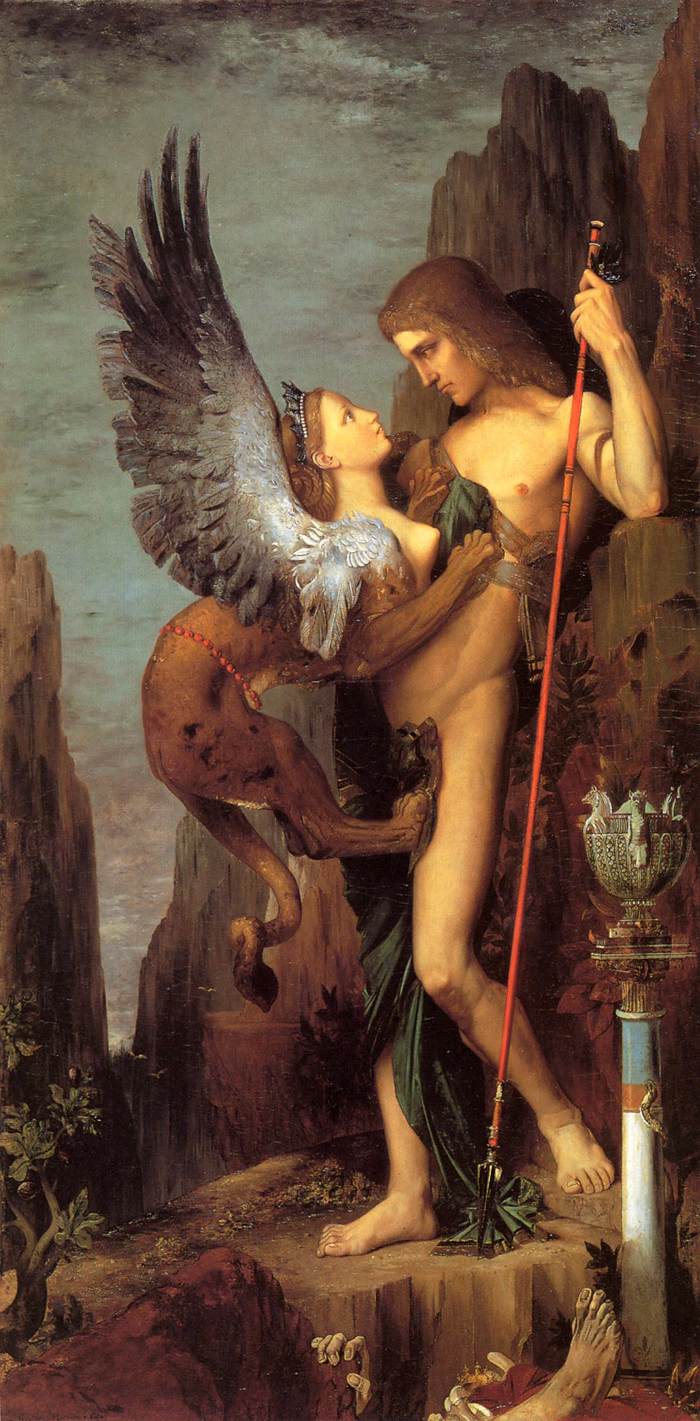 |
| Gustave Moreau, Oedipus and the Sphinx, 1864. |
The book’s cover describes it as a biography, but more accurately it should have been titled “an account of Mme. Blavatsky in relation to the esoteric tradition,” as Lachman’s scope is wide enough to place her in the context of modern esotericism. Here his other biographies serve him well, Swedenborg, Steiner, Ouspensky, Jung, even Hermes Trismegistus, are cited to give relevance to Blavatsky’s experiences. But the book fails as a biography, for in spite of giving so much attention to the details in her life we are still no closer to understanding the mysterious Mme. Blavatsky, who is made a little more mysterious by this book.
Part of the problem lies in Lachman’s trying to accommodate all versions of her story, though the pros win out over the cons. Blavatsky’s first book, Isis Unveiled, gets a fair amount of attention but The Secret Doctrine that she is more famous for gets a two page digest. There is nothing on her voluminous magazine output or her Russian fiction, so that the reader is left not really knowing what she stood for.
Perhaps this is due to an undue reliance on second hand sources, for the book offers no new research material. His last chapter, “The Masters Revealed?”, references Paul Johnson’s 1994 book of the same title where Johnson concludes that Blavatsky’s Masters were a front for real Indian insurrectionists of her time. As interesting as this theory is, Johnson also gives no motive for Blavatsky’s actions. What caused Mme. Blavatsky to spend so many laborious days in this supposed expenditure which her writing and editing was a cover for? Until that is answered these speculations must remain in the realm of theory.
Lachman writes that Johnson’s book, “perhaps more than anything else, is responsible for a kind of ‘Blavatsky revival’ taking place on the Internet, with scholars, Theosophists, and simply interested readers…” But the late Dr. Nicholas Goodrick-Clarke (an academic whom Lachman quotes approvingly) has more accurately pinpointed the “ Blavatsky revival” to the founding by Leslie Price of the journal Theosophical History, which in those pre-Internet days became the main means of exchange for a budding generation of theosophical scholars. This was in 1985 well before any version of Johnson’s book (Goodrick-Clarke, Theosophical History, Vol. XI July 2005, p. 23).
Madame Blavatsky: The Mother of Modern Spirituality offers a useful retelling of a story that needs to be told, especially coming from Mr. Lachman who has written so extensively on the subject of the modern esoteric. It serves as a welcome continuation of Joscelyn Godwin’s earlier book The Theosophical Enlightenment, taking up where the latter leaves off. Gary Lachman is now working on a biography of the British magician Aleister Crowley.
Thursday, November 1, 2012
Blavatsky, the Swastika and the Nazis
Replying to some online critics of his new book, Madame Blavatsky: The Mother of Modern Spirituality (Tarcher 2012), Gary Lachman posts the following in the comment section of the web magazine Reality Sandwich:
It’s a shame that much of the conversation about HPB in this thread has been devoted to the musty old myths about her links to National Socialism. They are very tenuous indeed, and in many ways amount to the fact that she used the swastika and wrote about race. The swastika we know has been in use for millennia, by peoples as far apart as North America and India; we may as well say that Native American Indians were proto-Nazis because they used it. More to the point, some - and I repeat some - of HPB’s ideas were co-opted and embellished by undeniably creepy people in Austria and Germany in the early part of the last century. HPB did indeed write about race, but so did Francis Galton and his cousin Charles Darwin, and later people like H.G. Wells, Bernard Shaw, Rudolf Steiner, and many others did as well - very nice and intelligent people in fact. In the vast corpus of Blavatsky’s writings - and just having written a book about her I have become quite familiar with them - race plays a relatively small part, and the tiny fraction she devotes to it has sadly become inflated to gargantuan proportions by hyper-sensitive and sensational attacks on her.
Sunday, October 21, 2012
Misinformation Files
A New Age writer named Stuart Wilde has posted an online piece titled “Blavatsky’s Frauds, Satan & the World Teacher.” Here are some of his claims:
H. P. Blavatsky founded the Theosophists. (“Theosophists” existed before Blavatsky came along, she helped found the Theosophical Society.)
She did psychic readings for people. (Though there is no evidence for this except, perhaps, in the writer’s imagination.)
Blavatsky worshiped Satan. (As proof he cites her as saying in The Secret Doctrine:) “Lucifer represents, life, thought, progress, civilization, liberty and independence. Lucifer is the Logos, the Serpent, the Savior. It is Satan who is the God of our planet and the only God.”
But these are not her words. It is hobbled together from two writers that she quotes in The Secret Doctrine: Mirza Moorad Alee Beg in vol. 2, p. 245, and Kingsford in vol. 2, p. 234, as giving their views.
She was investigated by the Society of Psychical Research, who found some indiscrete letters that Blavatsky had written to her maid, in which she detailed aspects of the frauds the two had perpetrated together. The Society of Psychical Research’s final report referred to her as one of the most ingenious and interesting imposters of history. (As if that was the final word and nothing has been written since.)
In the end Blavatsky was just a con artist, one that loved Satan.
We hope these words are not a testament to Stuart Wilde’s psychic abilities. For we note that his site offers for sale, Warrior’s Prayer Cards, advertising that “Stuart has touched and blessed each and every card. People use them as a form of remote healing and protection. They read the prayer and place the card on their body where there is pain, or on their heart if they are emotional or scared.” Each card sells for £2.00.
Mr. Wilde himself has not been without his critics and there is an internet thread titled “Why I dislike Stuart Wilde” along with a Stuart Wilde Exposed Facebook page.
Sunday, October 14, 2012
Blavatsky at the Dorothy Restaurant
The blog, Lost Womyn’s Space, covers the Dorothy restaurants in London started by Isabel Cooper-Oakley, one of Mme. Blavatsky’s pupils in the 1880s. Citing Franny Moyle’s Constance: The Tragic and Scandalous Life of Mrs. Oscar Wilde, it says:
Dorothy’s was the initiative of one Mrs. Cooper-Oakley, another of London's leading feminists, who also ran a milliner's business in Wigmore Street called Madame Isabel’s. It was an innovation, a restaurant for women only. Although dining for upper- and middle-class women was already available at the various women’s clubs, and although some conventional restaurants provided ladies’ dining room discreetly in upper storeys or side-rooms, Dorothy’s was a bold modern proposition. Its door was right on the street, and it was open to all classes of women, from shop assistants to duchesses. Offering cheap wholesome fare for all, Dorothy’s liberated the former from having to eat a bun in a shop and offered the latter a new kind of experience. You just bought an eightpenny dining ticket on entrance, took a seat at one of the tables and waited for your 'plate of meat, two vegetables and bread' to arrive. For an extra couple of pence you could also get pudding, and for a further penny tea, coffee or chocolate.
There are some interesting links to Blavatsky in the account. At the opening of the restaurant at 448 Oxford Street on June 21, 1889, among those present were Mme. Blavatsky, Countess Wachtmeister, and other theosophical lady notables.
Background on Isabel Cooper-Oakley is provided at the blog The Oakleys of Salop and London. After her marriage to Alfred Oakley in January 1884, he added her surname to his, becoming Cooper-Oakley. She died in Budapest, Hungary, on March 3, 1914.
The presence of Constance Wilde, wife of Oscar Wilde, as part of the London theosophical scene, has already been noted by us here.
Thursday, October 4, 2012
Blavatsky on Buddhism and Anna Kingsford
Theosophical History, vol. XVI, no. 1, dated January 2012, has just been released. It features a reprint of a newspaper interview with Mme. Blavatsky from the New York Sun of May 6, 1877, titled “Catechizing a Buddhist,” where Blavatsky explains the tenets of Buddhism, and a reprint of two obscure pieces relating to the Anna Kingsford’s Hermetic Lodge of the Theosophical Society: its Prospectus and a December 21, 1883, letter from Blavatsky to Kingsford. The main article deals with the early years of Edward Arthur Wilson (1874-1934?), known as Brother XII, who ran a theosophically influenced group, the Aquarian Foundation, during the 1920s.
John Patrick Deveney who supplies the notes to Blavatsky’s “interview” in the N.Y. Sun points out that Blavatsky had written to her sister on June 8, 1877, saying she had finished an article on Nirvana and the conceptions of the ancient Buddhists concerning God, the immortality of the soul and cosmogony for a newspaper. So it may be less of an interview and more of a piece written by Blavatsky. This would explain the editorial note added to that day’s issue advising: “Don’t believe in Buddhism unless you are very sure what you are about.”
Some of the ideas attributed to Blavatsky presage her later pronouncements:
“Buddhism,” said Madame Blavatsky, “is the ‘wisdom religion,’ and it underlies all religions in their purity. It is perfect monotheism, for it accepts one boundless, infinite incomprehensible principle, which the intellect of man can not understand. It is a philosophy, as well as a religion, and you must be careful not to confound the philosophy with the myths and dogmas and inconsistencies and absurdities with which the superstition of many generations of worshipers has encumbered it.”
Single issues are available for $8.00 /£5.00 from Theosophical History.
Subscribe to:
Posts (Atom)