Thursday, March 31, 2011

Conference Announcements


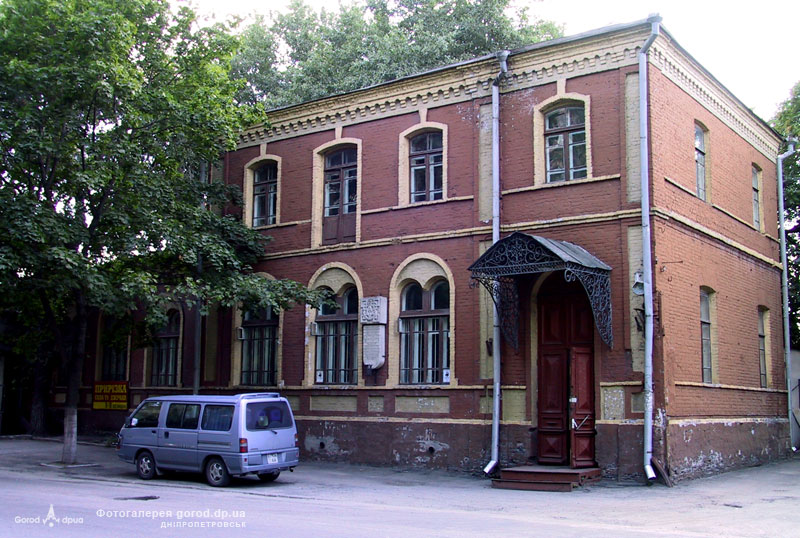
Blavatsky's birthplace in Dnipropetrovsk, Ukraine

*  Commemorating the 180th birth anniversary of Helena Petrovna Blavatsky and the 120th year of her passing, HPB’s birthplace, Dnipropetrovsk (then Yekaterinoslav, Russia), will be the site of a Forum that will “focus on the influence of HPB’s ideas on the development of science, transnational cultural cooperation and study of spiritual traditions of the East and West.” The event is organized by the H.P.Blavatsky and Her Family Museum Center (Dnipropetrovsk), Ankh CulturalFoundation (Kiev), the Sofia Theosophical Association, the Yavornitsky Historical Museum (Dnipropetrovsk), and the Committee for ethics and humanitarian expertising (Kiev).

Scheduled for June 23-26, 2011, in Dnipropetrovsk, Ukraine, the announcement and contact information are available here.

*  The European School of Theosophy will be having its annual meeting this year in St. Albans, England, just north of London. The syllabus includes John Gordon and Christian Bodhi, from England; Eric McGough, from Wales; John Algeo via Powerpoint and Pablo Sender, from the U.S.A., along with the directors of the School, Harold Tarn, Colin Price, and David Roef. Since the theme of this year’s session is on “Studies in the ‘Mahatma Letters’,” lectures will deal with “The Nature of the Monad,” “The Theosophical Society and the Masters of Wisdom,” “Mahatmas on the Limits of Knowledge,” “Life after Death with the Mahatmas,” and similar erudite matters. There will be two talks in the morning, two most afternoons, and an evening session at 8 PM. It is reassuring therefore to see that the last day will be devoted to a tour of Windsor, including Windsor Castle, and a walking tour of Oxford.

The School will be meet October 6-12, 2011. The brochure and registration information can be found here.

*  Dr. April Hejka-Ekins, professor at California State University Stanislaus, will be one of the featured speakers at the 76th Annual Convention of the Texas Federation of the Theosophical Society in America. Since one of Dr. Hejka-Ekins areas of specialty is ethics, it will be interesting to hear how she approaches her subject: “The Ethics of HP Blavatsky.” The other featured presenter will be Jerry Hejka-Ekins, her husband, one of the premier historians of the Theosophical movement in America. He will expound on “Key Ideas in H.P. Blavatsky’s The Secret Doctrine.”

The Convention will be held April 29 to May 1, in San Antonio, Texas. Program and registration can be accessed here.

Revisiting the Spiritual in Art


From March 30 through April 8th the BFA Fine Arts Department at the School of Visual Arts, New York, will be hosting an online Symposium having as its theme the publication of Kandinsky’s Concerning the Spiritual in Art a century ago. The project, Beyond Kandinsky: Revisiting the Spiritual in Art, will feature a number of noted artists, writers, filmmakers, and educators brought together online by this common theme. Session I: The Spiritual Then and Now, raises a number of questions relevant to this dialogue. In response, one of the presenters has noted:

As the focus of this symposium is “Going Beyond” the views Kandinsky presented about art and spirituality in one book, On the Spiritual in Art, it’s important to realize that he was strongly influenced during the eight years or so of journal entries that became that book by the enthusiasm among young artists in Germany and elsewhere then for the spiritual orientation called Theosophy. (Before and after that period, Kandinsky’s main spiritual orientation was Russian Orthodox Christianity.) When Mme. Blavatsky framed Theosophy in her two major books, Isis Unveiled (1877) and The Secret Doctrine (1888), her goal was to jump in front of the “parade” formed by the huge following that Darwin had. She trumped Darwin by announcing that the evolution he describes is merely material but that the evolution she describes is far larger, greater, more subtle, and encompasses “the merely material.” This idealist, anti-material bias to the spirituality in Kandinsky’s book is still available in many quarters (in fact, Theosophy itself still lives), but with our planet in extremely serious ecological peril, attention to transcendent levels of being without attention to the physicality of our existence and that of the entire Earth community is irresponsible and destructive. The idealist orientation is clearly something we need to “go beyond.”

Yet, Blavatsky may not be as other-worldly as the writer imagines. In her last lead article, “Civilization, the Death of Art and Beauty,” she warned:

Owing to the triumphant march and the invasion of civilization, Nature, as well as man and ethics, is sacrificed, and is fast becoming artificial. Climates are changing, and the face of the whole world will soon be altered. Under the murderous hand of the pioneers of civilization, the destruction of whole primeval forests is leading to the drying up of rivers, and the opening of the Canal of Suez has changed the climate of Egypt as that of Panama will divert the course of the Gulf Stream. Almost tropical countries are now becoming cold and rainy, and fertile lands threaten to be soon transformed into sandy deserts. A few years more and there will not remain within a radius of fifty miles around our large cities one single rural spot inviolate from vulgar speculation.

In scenery, the picturesque and the natural is daily replaced by the grotesque and the artificial. Scarce a landscape in England but the fair body of nature is desecrated by the advertisements of “Pears’ Soap” and “Beecham’s Pills.” The pure air of the country is polluted with smoke, the smells of greasy railway-engines, and the sickening odours of gin, whiskey, and beer. And once that every natural spot in the surrounding scenery is gone, and the eye of the painter finds but the artificial and hideous products of modern speculation to rest upon, artistic taste will have to follow suit and disappear along with them.

Information about this Symposium and comments by the participants can be seen here.

Sunday, March 27, 2011

Live and Learn


The site Casus Belle Époque has been following the development of different schools of Buddhism. It has now reached the point of what it describes in a post on March 22 as “The ‘Discovery’ of Buddhism,” noting that “Works of Indian Buddhism weren’t discovered by Europeans until around the 1820s”:

Abraham-Hyacinthe Anquetil-Duperron searched for the ancient works of Zoroastrianism in this connection (and found the ancient Hindu Upanishad scriptures translated from the Sanskrit into Persian instead, which he, in turn, translated into Latin). His work was the origin of the theosophy movement begun by Perennial Philosophers, Madame Blavatsky and Henry Steel Olcott, who later professed to be Buddhists. I will discuss their link to Gandhi and thus to “Engaged Buddhism” in the next post.

Like John Gray making Mme. Blavatsky a “nightclub singer” among other things in his book The Immortalization Commission, the work of Anquetil Duperron (1731-1805) is now made the “origin of the theosophy movement.” As great as Duperron’s work was making Zoroastrian texts and the Upanishads available to Europe in translation, this is another first: to claim it as “origin of the theosophy movement.”

Although the writer promised to discuss the Theosophists’ link to Gandhi, and though subsequent posts have dealt with him, nothing further on the subject has appeared on their site. Just as well. Gandhi’s image has received a new examination by Joseph Lelyveld in his book: Great Soul: Mahatma Gandhi and his Struggle With India, to be released by the American publisher Alfred A. Knopf later this month. The review in the March 26 edition of The Wall Street Journal emphasizes some of the unflattering parts, as can be seen here. Joseph Lelyveld was executive editor of the New York Times until recently. He is the brother of David Lelyveld, known for his pioneering work on British India, Aligarh’s First Generation: Muslim Solidarity in British India, 1978.

Thursday, March 24, 2011

Misinformation Files


Later this month the publisher Farrar, Straus and Giroux in the U.S. will be releasing The Immortalization Commission: Science and the Strange Quest to Cheat Death by John Gray, Emeritus Professor of European Thought at the London School of Economics (not to be confused with John Gray, the U.S. self-help author). The book is already out in the U.K. from the publisher Allen Lane. Publisher’s Weekly, in its review of the book, calls it: “a nakedly scornful, fatalistic attack on human efforts to avoid extinction, both individual (cryonic preservation) and collective (anti–global warming initiatives). The historical underpinnings of Gray’s argument are rickety, especially the confused God-builder section, which swirls pointlessly around the story of H.G. Wells and a beautiful Russian spy. His argument that Soviet atrocities flowed from a mad longing to transcend death is free-associated rather than reasoned, and his implicit yoking of dotty British psychics with Stalin’s executioners reveals little.”

In the section on Henry Sidgwick, F.W.H. Myers, and the Society for Psychical Research, Gray writes:

The arrival of Helena Petrovna Blavatsky in Cambridge [in 1884] seems to have been one of the episodes that led Sidgwick to conclude that proof might never be found [for post-mortem survival]. Initially Sidgwick welcomed Madame Blavatsky, a former circus equestrienne, entrepreneur (earlier in her career she founded an ink factory and an artificial flower shop, both of which failed) and sometime informant of the Tsarist secret police and nightclub singer who had taken up the profession of medium. Founding the Theosophical Society, Blavatsky published one of the canonical texts of Western occultism, Isis Unveiled. The earnest Cambridge philosopher found Blavatsky ‘a genuine being, with a vigorous nature intellectual as well as emotional and a real desire for the good of mankind’. He seemed unfazed by her claim to be receiving letters of esoteric wisdom from mysterious Tibetan masters. It was only after a thoroughgoing SPR [Society for Psychical Research] investigation that Sidgwick recognized that Blavatsky was a charlatan and an imposter.

If his mythologizing of Mme. Blavatsky is any indication of the accuracy of the rest of the book, then we must agree with Publisher’s Weekly: “The historical underpinnings of Gray’s argument are [extremely] rickety.”

This can be attributed to the sloppiness one occasionally finds in academic writing by authors who are out of their league and who expect the reader to take their words as ipse dixit, but what can one think when a theosophical publisher puts out the following:

According to Blavatsky and Olcott, ancient Europe had inherited pieces of a unified tradition that had originated in the far reaches of Asia. The source was still intact, and core teachings concerning the spiritual evolution of humankind were still kept secret by this “Great White Lodge” in the vastness of the Himalayas. Blavatsky claimed that she in particular had been contacted by the hidden adepts, or “Mahatmas,” of this lodge in mediumistic trance and that they had tasked her with now revealing their teachings. Apparently Blavatsky’s form of communication with the Mahatmas was insufficient, for she, Olcott, and many other Theosophists would journey for years throughout the Middle East and most of South Asia to meet them.

Modern studies about Blavatsky would have been greatly enriched if the author, Yannis Toussulis, had provided the source of Blavatsky’s “claim.” But to no avail, and the book, Sufism and the Way of Blame, from Quest Books from the Theosophical Society headquartered in Wheaton, Illinois, leaves us unenlightened. The book is appropriately scheduled for an April 1st release. Blavatsky herself never used the term “Great White Lodge.”

Sunday, March 20, 2011

Baseball in the Garden of Eden


In every country where Theosophy has taken root, it has been assimilated in a distinct and local way: in India and Australia, it was through political and educational life; in England, in areas like woman’s suffrage and other social movements; in various parts of Europe and Canada, in the arts; in the U.S.A., through fiction, music, and a connection with baseball.

The story of Theosophy’s connection with the sport of baseball usually gets a passing reference, mainly because of Abner Doubleday’s involvement with the group. John Thorn, who has numerous books on the subject of baseball, has written Baseball in the Garden of Eden: the secret history of the early game, just published by Simon and Schuster. Doubleday had been named President, pro tem, of the Theosophical Society after Olcott and Blavatsky left for India in 1879. After his death in 1893 he was elevated to founder of baseball mainly through the efforts of a group of Theosophists and their cadre, most notably, Albert Goodwill Spalding, the sporting goods magnate, and his second wife, Elizabeth Mayer, a close friend of the theosophical leader, Katherine Tingley—at least this is Thorn’s belief:

Theosophists were a secret society opposed to organized religion, hoping to convert the masses through spiritual flimflam. More troubling to those inclined to see conspiratorial plots in Theosophy were its philosophical underpinnings in Tibetan Buddhism. While widely respected today, this religion was regarded by Orientalists of the nineteenth century as Lamaism, a faith radically apart from mainstream Buddhism and one that was dominated by magic or even black magic. Blavatsky fed this flame with her slight of hand tricks and her “precipitated” letters from venerable Tibetan masters (the “Himalayan Brotherhood”), written documents that would mysteriously appear in her possession following a question arising from a session with skeptics.

Which shows that one can be an expert in one area and not in another.

Doubleday’s distinguished early career in the Union Army during the American Civil War has already been covered in the Blavatsky News post of July 15, 2010, on Thomas Barthel’s Abner Doubleday: a Civil War biography published last year.

Der Blaue Rieter


Art History Unstuffed of March 18 gives a brief history of Der Blaue Rieter (The Blue Rider), a group of artists in Germany in the early part of the twentieth century, the best known member of which is Wassily Kandinsky.

In 1912, Kandinsky wrote Concerning the Spiritual in Art, which fused Theosophy and the teachings of Rudolf Steiner and Madame Helena Blavatsky on the universality of all elements. Like many of the art colonies in Germany, their intense interest in all things spiritual was paradoxical. The Blue Rider came to an end by the Great War when it broke out in August, 1914 and scattered the artists. Leaving Gabriel Münter behind in Switzerland, Kandinsky returned to Russia where he married his second wife. Tragically, Franz Marc was killed in action. Kandinsky and Klee were reunited after the War at the Bauhaus, where the now-mature artists were installed as master teachers.

Art History Unstuffed, which describes itself as “a new way to learn the history of art, on line, at your convenience, in your own time, on your own terms,” notes:

For too long art history has been held hostage by scholars speaking to scholars and not to people. The purpose of this site is to educate and to inform and to do so with respect to the intelligence of the readers. Designed as a site for serious students of art history in need of solid substantive material, Art History Unstuffed is written for Twenty-First century learners who prefer reading “text-bytes” and “sound-bytes” of targeted information. Written by a published scholar who has researched and consolidated both well-respected classical sources and vetted the latest research, this site creates a middle ground between arcane scholarly jargon and informed discourse that is accessible to all.

This post and many others of interest, such as Orphism and Simultaneity, Late Nineteenth Century Social Philosophy, and the Pre-Raphaelite Brotherhood, trends that would have been part of Blavatsky’s world, can be accessed here.

Sunday, March 13, 2011

Blavatsky and Elliott Coues


The blog of the American Birding Association for March 10 carries a brief note about ornithologist Elliott Coues’s association with Theosophy.

It’s not the strangest thing a birder has ever done, but Elliott Coues’s association with the American Theosophical Society remains a remarkable chapter in the history of ornithology. Coues joined Mme Blavatsky's gang in 1880, and by mid-decade had ascended to the presidency of the Society, only to be expelled as an apostate in 1889.

Coues brief trajectory through the Theosophical Society is given a chapter in his 1981 biography, Elliott Coues: naturalist and frontier historian, and more specifically in Michael Gomes’ “History of a Humbug,” in The Canadian Theosophist, 1984-86, which gives HPB’s letters to Coues, and his Witness for the Prosecution, 1993, with Annie Besant’s deposition in the libel case Blavatsky brought against Coues and the New York Sun.

Elliott Coues (1842-1899), an American ornithologist of note, met Olcott and Blavatsky in Europe in 1884 and was made head of the Theosophical Society’s newly formed American Board of Control. In 1886 Olcott dissolved Board of Control and created the American Section of the Society. W.Q. Judge was voted its leader and Coues was furious, writing letters threatening dire consequences if he was not made President in America.

In the April 30, 1889, letter that closes her correspondence with him, HPB wrote:

You will not move me by either threats, sweet irony, or Parthian arrows—because I am not a “woman in general.” And also because I have become of late a dead body, dead to outside influence, dead to love or hatred, to praise or blame, and that the few years, or perhaps days I have to live, I have determined to devote to the service of the God within me, and my terrestrial or Earthly master, who is beyond the Himalayas.

Work for the Society and show me that you can do it good, real good, and my life will be at your service. Go on flapdoodling, attempting to play with me as cat plays with a mouse, and the latter will prove too strong for you.

There is a a story about a freethinking hero, or perhaps a president of the United States, whom Satan would not have in hell, and therefore gave him a box of matches and some coals, asking him to go and make a hell of his own.

A Persian proverb says: “He who spits against the wind, receives it back in his face.” Better swim with, than against the tide.

Coues responded with a scandalous interview about Blavatsky that appeared in the Sunday New York Sun of July 20, 1890. HPB sued for libel, but her death terminated the suit. A year after her death the Sun published a long sketch of her life by Judge as a corrective to Coues’ statements, adding: “we desire to say that his allegations respecting the Theosophical Society and Mr. Judge personally are not sustained by evidence, and should not have been printed.

Gomes says: “Elliott Coues died on Christmas Day, 1899, at John Hopkins Hospital in Baltimore, Maryland, where he had gone for surgery for cancer of the rectum. He passed away from the exhaustion of the operation.”The Canadian Theosophist, Jan-Feb 1986, p. 137.