Sunday, May 29, 2011

Rebirth of a Poet


The New York Times Book Review of May 27 carries a review of a new translation of the Songs of Kabir by Arvind Krishna Mehrotra. The reviewer, August Kleinzahler, compares it with previous translations:

Arvind Krishna Mehrotra’s new translation of Kabir brings the poetry of the great 15th-century Indian poet and holy man to life in English for the first time. Not that others haven’t tried: Pound, Robert Bly and, most notably, Rabindranath Tagore in 1915, with a version consisting of thees, thous and thines, delivered in a sandalwood-scented prayer-book-ese that would not have been out of place atop a teak sidetable at one of Mme. Blavatsky’s legendary seances. But it is Mehrotra who has succeeded in capturing the ferocity and improvisational energy of Kabir’s poetry.

We’re not quite sure what “legendary séances” the reviewer is referring to, but Tagore was a favourite with early twentieth century theosophists. The review, which gives a number of examples of the new translation, can be read here.

Thursday, May 26, 2011

Blavatsky and Science Fiction


Locus Online, the website of the magazine of the science fiction and fantasy field, carries a May 25 review by Stefan Dziemianowicz of a new collection of short stories by the American science fiction writer Henry Kuttner. He points out how the writer referenced his tales.

Probably the most interesting aspect of Kuttner’s shudder pulp stories is their esoteric references to the work of Arthur Machen, Algernon Blackwood, and other writers of supernatural fiction, as well as the teachings of celebrity occultists like Madame Blavatsky. (References to The Book of Dzyan, an ancient book of Tibetan lore that Madame Blavatsky was fond of flogging, appear in several tales, notably the title story.) Like his mentor, Lovecraft, the young Kuttner was reading and absorbing the work of a lot of different writers, and he knew that mentioning them in a story helped to enhance the verisimilitude of the seemingly supernatural shenanigans.

Blavatsky’s influence in the field of science fiction is another area that has not received enough attention. The collection by Kuttner (1915–1958), Terror in the House: The Early Kuttner, Volume One, is comprised of stories published in the 1930s. The rest of Stefan Dziemianowicz’s review can be read here.

Sunday, May 22, 2011

Blavatsky and Australian Art


The Sydney Morning Herald for April 30, 2011, has a long review of the exhibition at the Queensland Art Gallery, Brisbane, Art, Love and Life: Ethel Carrick and E. Phillips Fox, on the two Australian artists.

The Foxes were a successful partnership, both as husband and wife and as two artists working in complementary styles. Emanuel Phillips Fox (1865-1915) was academically trained and naturally cautious in his version of impressionism. Seven years his junior, Ethel Carrick (1872-1952) was a more adventurous painter. Each had much to offer the other. The tragedy is that their marriage lasted a mere 10 tears before Fox - a chain smoker - died of cancer at the age of 50.

The reviewer notes “Carrick’s burgeoning interest in Theosophy - Madame Blavatsky's fizzy cocktail of ersatz ancient wisdoms that enjoyed a remarkable vogue among artists at the time. Mondrian and Kandinsky were fellow believers, so Carrick was in good company.” The rest of the review can be read here. The exhibition, which runs until August 7, “offers unprecedented access to more than 100 paintings, works on paper and ephemera exploring the artists’ lives, subjects and milieu, drawn from major institutions and private collections across Australia.”


Ethel Carrick
Arabs bargaining c.1911. Painting oil on canvas

The Poet as Prophet


New York poet Eric Norris publishes an extended meditation on “Madame Blavatsky, Poetry, and Me: An Appreciation” on his blog When I was One and Twenty.

It is not easy to overestimate the influence of 19th Century Theosophist thinker Madame Helena Petrovna Blavatsky on the development of modern poetry; but it is always possible to try.

Helena Petrovna remains, if she remains in our minds at all, a mystery, a medium, a mystic—an enchanting metaphor, perhaps—the raisin in our rice pudding, if you will. Numerous numerologists have noted (with hysterical hand-rubbing) the mathematical symmetry of her name—the very recipe for collective wisdom as it is received around a workshop table.

How then, you may be inclined to ask, can we know Madame Blavatsky, if not from the Internet? How do we approach her? How do we embrace the sorrowful soul buried beneath her ample bosom, poetically speaking? Posthumously, of course, and with reverence, yes. But how do we distinguish her from the fraud in her photographs? From her books? From a trance? From France?

The rest of his ruminations on the subject can be read here.

Thursday, May 19, 2011

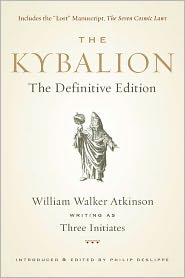
The Kybalion


The Kybalion is one of an elect set of metaphysical books from a century ago that have remained in print and have had a continued readership. Subtitled “A Study of the Hermetic Philosophy of Ancient Egypt and Greece” by Three Initiates, it purported to come from “a compilation of certain Basic Hermetic Doctrines, which were passed on from teacher to student, which was known as the KYBALION.” The main part of the book served as a commentary on Seven Hermetic Principles that were enunciated.

In his Introduction to the “Definitive edition” of the book just published by Tharcher/Penguin, Philip Deslippe reveals the author to be William Walker Atkinson (1862-1932), a prolific writer living in Chicago at the beginning of the twentieth century. Atkinson is better remembered today for his series of yoga books published under the name of Yogi Ramacharaka. Deslippe concludes: “the source material for The Kybalion of 1908, despite all the myth and lore surrounding it within the introduction, appears to have never existed at all. The Kybalion expounds on a center that was either imagined or employed purely as a device. The only literary parallel to this would seem to be the Book of Dzyan, a supposed primeval work of cosmology, which the founder of Theosophy, Helena Blavatsky, claimed to have read and memorized in Tibetan Lamaseries. Her landmark 1888 work, The Secret Doctrine, can be considered a type of exegesis on the Book of Dzyan, although some scholars in her time considered it a more a reworking of texts already existent. William Walker Atkinson was clearly an admirer of Blavatsky, and Theosophic traces can be found in most of his works.”

Philip Deslippe’s interesting introduction gives further background on the man who also wrote as Theron Q. Dumont and Magnus Incognito.

Sunday, May 15, 2011

The Mongolian translation of Blavatsky’s The Voice of the Silence


Matri Books of Mongolia, in cooperation with Quest Books and the Theosophical Society in America, has published a Mongolian/English edition of H. P. Blavatsky’s Voice of the Silence. In the Foreword to this edition, Glenn Mullin writes:

Blavatsky was the first Westerner to present Tibeto-Mongolian Buddhism in an authentic and sympathetic light. Earlier Western writings had largely been done by Christian missionaries, who looked at the tradition through glasses distorted by Christian prejudices of 18th and 19th century Europe. Blavatsky had the advantage of a naturally open spirit, that could look at all world traditions with an appreciative intellect. Moreover, she encountered the teachings of Mongolian lamas in her childhood in Russia, and visited Mongolian temples in Kalmukia. She traveled widely in India and Tibet, and even claims to have visited Mongolia itself. Later in life she adopted two mystics from Tashi Lhunpo Monastery in Tibet as her two deepest sources of spiritual inspiration.

The English in this edition has been updated by David Reigle, mainly in the changing of “thus,” “thou” and “thine” to “you” and “your,” and the addition of Sanskrit and Tibetan spellings after terms used in the book. In an Endnote Mr. Reigle suggests that the methods outlined in the First Fragment of the Voice of the Silence “clearly corresponds primarily to the Raja-yoga system of Patanjali.” Some of Reigle’s other conclsuions are gone over in a May 11 post at the site Everything Related to Mongols and Mongolia.

A Foreword by H.H. the Dalai Lama to Raghavan Iyer’s 1989 edition of Voice of the Silence had been added. Doss McDavid in his Introductory Note tells of the work of the Roerichs and hopes that “the people of Mongolia find inspiration in the works transcribed by this ‘fiery messenger of the White Brotherhood’.” At 121 pages, the book sells for $12.95 U.S., 5000 tögrög in Mongolia.

Blavatsky News


* The New York Times carries a review of John Gray’s new book The Immortalization Commission, commented on in a March 24 post here. The reviewer, Clancy Martin, professor of philosophy at the University of Missouri, Kansas City, mentions an incident in book concerning a visit to Russia by H.G. Wells:

Wells had proposed an ambitious program, in which “an intelligent few — scientists, engineers, aviators, commissars — could seize control of evolution and lead the species to a better future” and “eventually, humans would become like gods.” Wells’s great fantasies charged the batteries of mystically inclined intellectuals like Madame Blavatsky, G. I. Gurdjieff, P. D. Ouspensky and especially Gorky, a celebrated writer on friendly terms with Chekhov, Tolstoy and Lenin. Like Sidgwick before him, Gorky was convinced that the human personality, which he believed to produce “thought-energy,” was eternal, and essentially interwoven with the fabric of the universe. Unlike Sidgwick, Gorky believed that humans could evolve into “gods” and eventually influence the development of the universe itself — a notion that gave birth to a pre-revolutionary movement called “God-building.” “A kind of secular mystery cult, God-building was another part of the late-19th-century European current in which occultism and science marched hand in hand,” Gray writes.

“Mystically inclined intellectuals like Madame Blavatsky”! An online version of the May 6 post, “The Scientific Revolt Against Death,” can be read here.

* V. Narayan Swami who posts the blog, Rabbiting On, takes us to task for pointing out some errors in a 2008 post by him mentioning Hudleston’s Garden, the Madras property purchased by Olcott and Blavatsky in 1882 as headquarters for the Theosophical Society. His comments are served up with a good dose of mockery and attempted sarcasm. “What makes Theosophists come down from the supposedly high ground which they occupy to take issue with an obscure blogger,” he writes in his self-justifying post of May 3, though admitting that we were correct in at least one instance!

In regard the property he describes as Hudleston’s Garden, we must agree to disagree: the building he indicates it to be has two stories with rooms on the top, while Hudleston’s Garden (at least when the Theosophists bought it) was a one story building with rooms on the roof. In response to our query as to what happened to these buildings, for there is no indication of them at present on the property owned by the Theosophical Society, he coolly says: “I consider them to be buildings outside the estate and on the other side of the Elphinstone bridge,” though not stating so in his original post.

And if the artist could take such liberties (the point of “The Indian Picturesque: Images of India in British Landscape Painting, 1780-1880,” in C.A. Bayly’s An Illustrated History of Modern India, Oxford University Press, New Delhi, 1991, how European landscape artists manipulated the portrayal of India), could he not imagine other structures? Since, as V. Narayan Swami says: “the centerpiece of my [his] blog story” was “my [his] attribution of Hudleston House,” we can understand the difficulty of his position, for the validity of any other viewpoint would be impossible. As Blavatsky News is an attempt to share the collected research of those who post here, made possible by the global contribution of our readers, we commend any attempt to decipher this intricate field, and V. Narayan Swami’s entry into the murky waters of Theosophical history can be read here. For us, it is not so much about the building but what happened there.