Thursday, June 19, 2014

Blavatsky in Dublin


Dublin’s Hugh Lane Gallery announces the opening of a new exhibition influenced by Blavatsky. Titled A Modern Panarion: Glimpses of Occultism in Dublin:

AE's Theosophical murals at the lodge
of the Theosophical Society in Dublin, 1895

This exhibition features contemporary artists whose works resonate with ideas central to the belief system of The Theosophical Society. The Society was founded in New York in 1875, espousing a doctrine synthesised from esoteric religious, philosophical, and scientific ideas and aspiring toward the formation of a universal community in which all religions, creeds, and races were equal. The popularity of Theosophy in the late-nineteenth and early-twentieth centuries was considerable, rapidly attracting a community of adherents worldwide from amongst the many disenchanted people who sought spiritual guidance and vital inspiration in an increasingly secular and industrialized world.

As one reviewer noted:   The ideas posited by A Modern Panarion, then, are not so much that a Theosophical Society is alive and kicking in Irish contemporary art, but that the traces of ideas raised by the Theosophists have perhaps been assimilated or passed down via pop culture. A lot of the Society’s thoughts on religion and philosophy would eventually resurface in new guises over the course of the 20th century – perhaps most notably during the counter-cultural movements of the 1960s, and the science fiction of the 1970s. Through these third parties, connections can be drawn to the artists participating in the show.

The exhibition takes its name from a volume of Blavatsky articles issued soon after her death, A Modern Panarion. Its title comes from the Greek, meaning “Medicine Chest,” a famous work by the fourth century bishop of Salamis, Cyprus, Epiphanius, intended as a “stock of remedies to offset the poisons of heresy.”

The exhibition is curated by Padraic E. Moore, who has issued an accompanying publication To Seek Where Shadows Are that chronicles of the emergence of the Theosophical Society’s Dublin Lodge. A Modern Panarion: Glimpses of Occultism in Dublin will run from June 19 to September 7, 2014.

Sunday, June 15, 2014

Mondrian and Blavatsky


The online edition of London’s Financial Times for June 15 reviews the exhibition “Mondrian and his Studios” at the Tate Liverpool. One of the draws is a replica of Mondrian’s studio in Paris from the 1920s. Looking for influences, the reviewer says:

Mondrian’s chosen faith was theosophy. Championed at the turn of the 20th century by Madame Blavatsky and Annie Besant, it was fallen upon by a clutch of artists who interpreted its credo – that the divine essence of reality was a union of spirit and matter – as a manifesto for an art that aimed at universal enlightenment. 

However esoteric it sounds, theosophy made for masterpieces. (Kandinsky was a fellow traveller.) It captured Mondrian’s imagination in 1909, while he was still in Amsterdam. In 1911 he left for Paris and his spiritual vision found its secular medium in cubism’s crystalline dissections.

“Mondrian And His Studios”, which commemorates the 70th anniversary of the Dutch artist’s death, is the largest UK exhibition of work by the abstract painter. It will be on view from June 6 to October 5, 2014.

Tate Liverpool’s recreation of Mondrian's studio in Paris

Blavatsky Related


The Lilly Library is the rare books, manuscripts, and special collections library of the Indiana University Libraries, Bloomington. The Library’s summer exhibition, “Spiritualists, Sorcerers, and Stage Magicians: Magic and the Supernatural”, “offers a view of how ideas of the occult, the unseen, and the supernatural have persisted and transformed throughout history, from the Middle Ages to the 21st century. Indeed, if popular entertainment is any indication, it seems evident that our interest in ghosts, ghost-hunters, witches, and devils has never really abated, despite the rationalism and disenchantment of the modern age.”

Highlights of the exhibition include 17th-century treatises on witchcraft; a wide array of texts representing the complex social networks of spiritualist mediums, stage magicians, and psychical researchers in 19th-century Britain and America; issues from the Lilly's newly-acquired archive of Weird Tales magazine; and correspondence between book collector Montgomery Evans and notorious occultist Aleister Crowley.

The exhibition will run from June 2 to August 30, with a special reception on Saturday, June 21 from 6:00-8:00 PM.

Thursday, June 12, 2014

Blavatsky News


*   The Jamaica Gleaner of Kingston, Jamaica, carries an extended look at the subject of reincarnation by Dr Glenville Ashby, “a social critic and president of Global Interfaith Council, NYC”. In Part 1, which appeared on May 25, he says of the subject:  “Interestingly, this doctrine has seeped into Western religious teachings, courtesy of Helena Petrova Blavatsky, who founded the Theosophical Society, after having spent many years in India.”

In Part 2, published June 1, he talks to a medium who lets him know: “And of Helena Blavatsky, the woman who single-handedly popularised reincarnation in the West, Ross says, ‘She has since communicated from the spirit world that she had erred in her belief in a fallacious doctrine.’” (!)

 
*   A Kindle edition of the Russian text of Vera Zhelihovskaya’s Truth About Helen Blavatsky is now available for those so interested. The text was initially published in the St. Petersburg paper Rebus in 1883 and deals with Blavatsky’s early life in Russia. An English translation in Mme. Blavatsky’s handwriting is in the archives at the international headquarters of the Theosophical Society, at Adyar, Chennai, India. Blavatsky’s translation was issued serially in The Theosophist, May to December 1991. Vera Zhelihovskaya was Blavatsky’s younger sister. 


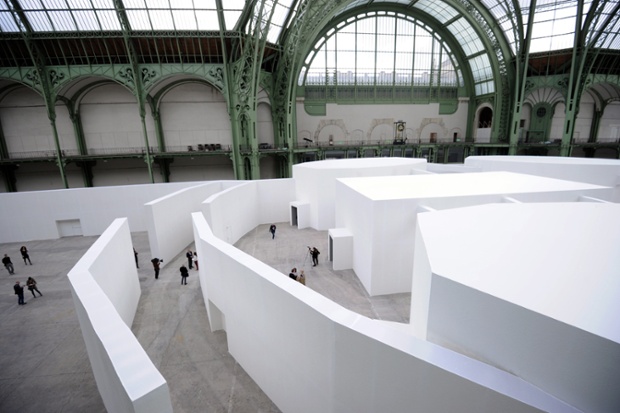
*   The blog of the British arts and culture magazine Aesthetica reviews The Strange City, an installation by Ilya and Emilia Kabakov at The Monumenta, Grand Palais, Paris:

Inspiration for this soaring colour-changing installation takes its roots from the theory of the Russian musician, Alexander Scriabin, who created a colour organ, “‪clavier à lumières”, appropriated the synesthetic system, and who was influenced by Newton’s Opticks and theosophical theories of Jean Delville and Helena Blavatsky.

Of the Soviet-born American conceptual artist, the piece notes:  At the end of 1960s and beginning of 1970s he followed the interest in transcendental and irrational questions, Russian theosophy of 19th and 20th centuries. Moscow and Leningrad artistic communities were gripped by the thought of art as a medium of purely religious and philosophical ideas, and at that time Kabakov started his series of white paintings, where an artwork becomes a screen for transcendental light projection.

So it comes as no surprise that among the spaces included are” Manas” and “The Centre of Cosmic Energy”. “Manas is a reconstruction of a mystical Tibetian city, existing, as artists suppose, on two levels – the mundane and the celestial, and surrounded by mountains, which makes communication with other worlds possible.” It will be on view from May 10 to June 22, 2014.


Sunday, May 25, 2014

Blavatsky in Hollywood


The Los Angeles Neighborhoods and Real Estate guide, Curbed LA, looks at “The Creation of Beachwood Canyon’s Theosophist ‘Dreamland’” that lasted from 1912 to 1924 when the community moved to Ojai, California, where they still reside.

The Theosophists were dreamers. “Theosophy, in its abstract meaning, is Divine Wisdom,” wrote movement founder Helena P. Blavatsky, who claimed to be a “missionary of ancient knowledge.” The Society soon became popular with educated, middle-to-upper class freethinkers in Europe, America, and India. 

Established in the Hollywood Hills as Krotona, “the community grew quickly along more haphazard lines, with architecture reflecting the Theosophist's ‘Eastern’ inclinations.” The rest of the piece covers examples of the architectural styles that have survived. With the departure of the group, “Most of the buildings at Krotona were quickly converted into apartments or continued on as private homes, and many still stand today, in various stages of repair. Crammed between the mish-mash of later Beachwood Canyon development, they still delight the eye and seem to be just a bit out of place.”

The history of the Krotona Theosophists has been devotedly chronicled in the volumes of Joseph Ross on the subject.


Krotona architecture today
A house on Temple Hill Drive designed by Marie Russak Hotchener

Sunday, May 11, 2014

Blavatsky News


*  A post at The Smart Set blog at Drexel University reminds us of the upcoming 100 anniversary of the birth of the American musician known as Sun Ra, born Herman Poole Blount on May 22, 1914.


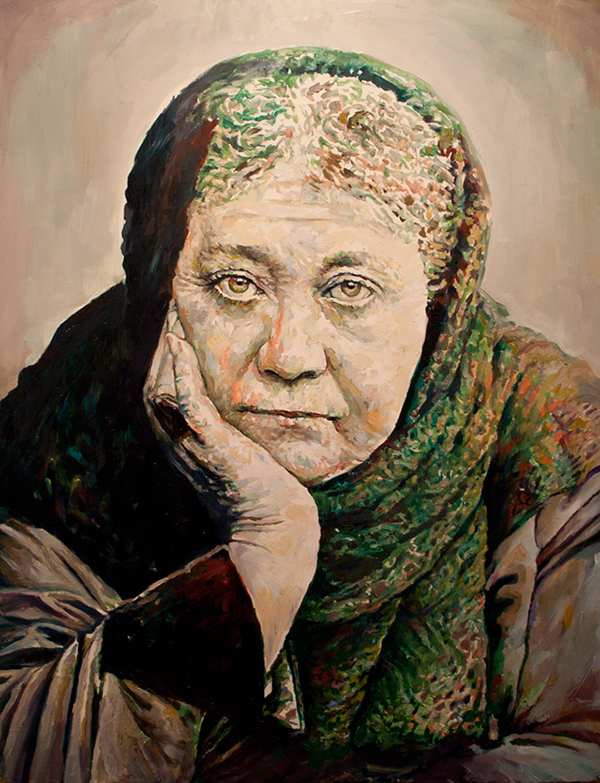
Cristian Blanxer, Barcelona, Spain
 oil on wood / 44 x 57,5cm /2014
Sun Ra believed that the whole of humanity was in need of waking up. He wanted to slough off old ideas and habits, brush off sleepy clothing and shake off drowsy food. Because present time mattered little to Sun Ra, they say he rarely slept. Even as a child, he would spend all his time playing the piano or composing. “I loved music beyond the state of liking it,” he once said. Sun Ra was just as obsessed with books — you couldn’t see the walls of his room for the books. Books contained words and the words held a secret code that, if unraveled, revealed truths about human existence. He read the ancient texts of Egyptians, Africans, Greeks, the works of Madame Helena P. Blavatsky (with whom he once shared the initials H.P.B), Rudolph Steiner, P.D. Ouspensky, James Joyce, C.F. Volney, Booker T. Washington. He read about the lost history of the American Negro and studied the origins of language. Sun Ra knew Biblical scripture better than any preacher, read Kabbalah concepts and Rosicrucian manifestos. Through these texts Sun Ra learned it was possible for the chaos of human knowledge to be ordered. Theosophy, relativity, mathematics, physics, history, music, magic, science fiction, Egyptology, technology — all were keys to a unified existence. Ideas and music carried a reclusive black boy from Birmingham and transported him into outer space. But the most important idea Sun Ra learned from all his reading, from all the knowledge he acquired, is how puny knowledge is in the face of the unknown. We need the unknown, Sun Ra said, in order to survive.


*  Dr. Christopher Scheer will address the impact of Theosophy on developments in modern art and music. "Founded in New York City in 1875 by a group that included the mystic Helena Blavatsky, the Theosophical Society united Western esoteric thought with Eastern philosophical and religious ideas in an attempt to understand the mysteries of the universe. The event “Art History: Enchanted Modernities-Theosophical Thought in the History of 20th century Art and Music” will be held Thursday, June 12, 5:30 pm at the Sun Valley Center for the Arts, Ketchum, the oldest arts organization in Idaho’s Wood River Valley.

Thursday, May 8, 2014

Two New Blavatsky Books


David and Nancy Reigle announce the publication of an early surviving draft of Blavatsky’s The Secret Doctrine. The manuscript, which is in the Archives of the Theosophical Society, headquartered at Chennai, India, was partially published in The Theosophist, August 1931 and October 1932 to November, 1933, and in 1897 as the Third Volume of The Secret Doctrine. It includes H. P. Blavatsky’s early translations of stanzas from the Book of Dzyan with her unrevised commentaries on them. There is a year by year chronology of the events leading to publication of The Secret Doctrine, and an extended study on “The Myth of the ‘Missing’ Third Volume of The Secret Doctrine” by Daniel H. Caldwell. The book, The Secret Doctrine Würzburg Manuscript, will sell for $18.95 and will be available through Lulu.com.


*  The Theosophy Company of Los Angeles has announced the publication of The Secret Doctrine Dialogues, “taken from the same stenographic notes as The Transactions of the Blavatsky Lodge.” This is essentially a reprint of the material published in 2010 as The Secret Doctrine Commentaries by the I.S.I.S. Foundation in The Hague but at a cheaper price: $35.00. Some typographical errors have been corrected and a new index added. All the careful Sanskrit transcription in the 2010 edition has been replaced by a mélange of dated 19th century terms, such as Parabrahm instead of Parabrahman, etc. Why Theosophists continue with such usage which makes their writings seem even more dated is beyond us. For those who want the original it is available online free from the publisher in The Hague here.

Unfortunately neither of these books will do much to make Blavatsky more accepted by the general public as the material contained in them is of a nature not to make easy reading. Specialists, no doubt, will be thrilled.


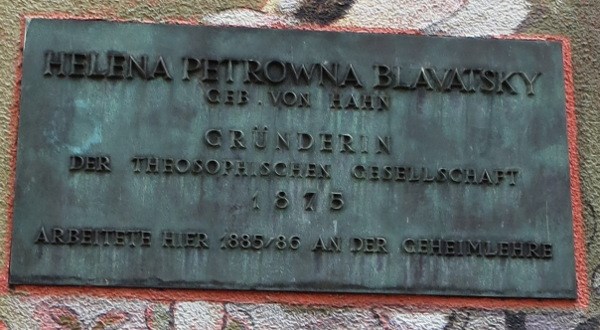
Plaque on the building in Würzburg, Germany, where Helena Petrovna Blavatsky 
once resided when writing The Secret Doctrine.