Sunday, March 13, 2011

Gandhi


The Australian Broadcasting Corporation (ABC) has been airing what they describe as “the first definitive series on Gandhi’s life, examining his controversial views on race and his role in Indian independence.” Journalist Mishal Husain follows the life and legacy of Mahatma Gandhi in this BBC production. The first installment traced his roots to his birth town in India and looked at the early influences on his life. A local commentator, Sudha Hamilton, notes on his blog:

Indeed Gandhi’s commitment to vegetarianism came to fruition, during his time in England, where he was studying law. He was exposed to a rich vein of social and spiritual practices in the great city of London, where he met many influential people. Gandhi became acquainted with Madame Blavatsky’s Theosophists and greatly admired their appreciation of the rich diversity of religions and spiritual approaches. He was very young, and I would imagine impressionable, as we all are in our youth, during his time in the capital of the British Empire.

Gandhi’s brush with Theosophy, or more specifically with Mme. Blavatsky and her circle in London, is often touted by Theosophists. While he acknowledges the influence those early Theosophists had on his awakening to the Bhagavad Gita, he was not as enthused about later developments in the Society. He wrote to Theosophist Ernest Wood in 1933:

I was invited to become a member of the Society when I was in Johannesburg, and I told the Theosophical friends that I could not join a Society which believes in secret methods and messages from invisible Mahatmas. I have always felt that these things are a serious hindrance in the search for truth.

Thursday, March 10, 2011

“Madam Blavatsky Lives”


Tavistock in Devon is known as one of the most elegant towns in the South West of England. The Tavistock Arts and Entertainment Centre, the Wharf, which hosts live concerts, theatre, cinema, an art gallery and events throughout the year, will be presenting a new play in June, “Madam Blavatsky Lives,” as part of this year’s programme.

Have you ever wanted to know about the future? Do you dream of wealth and happiness? Madam Blavatsky Lives will change your mind forever. It is a comedy which shows the affect of an all-knowing spiritualist on the lives of three women. Two of them are suddenly faced with dreadful futures and the other is suffused in happiness. Which one of them will be faced with their worst fear? Will the predictions come true? All of them? None of them? This play will make you laugh at their predicaments and cry at their heartbreaks. You will never think of fortune telling in the same way again! The play stars the original cast of ‘Mutton’ – Donna Flinn, Jean Heard, Julia Munrow and Julia Rufey, four actresses who are renowned for their great comedy skills and they will delight you all over again in this new play written by Joan Greening the creator of ITV’s ‘The Cabbage Patch’ and ‘Troubles and Strife’. If you want a hilariously spirited evening out – this is it!

Further information can be found at the centre’s site, here.

Cambridge Library Collection—Spiritualism and Esoteric Knowledge: Update


In a December 5, 2010, post Blavatsky News alerted readers to the forthcoming series from Cambridge University Press: Cambridge Library Collection—Spiritualism and Esoteric Knowledge. Some twenty books in the series—reprints of 19th century books on spiritualism, theosophy, anthropology and psychology—were anticipated. The list has now grown to 115 titles, which can be seen here. Scheduled for May release: Eliphas Levi’s Dogme et Rituel de la Haute Magie, two volume set, £42.00; Daniil Avraamovich Chwolson’s  Die Ssabier und der Ssabismus, two volumes, £70.00; Olcott’s People From the Other World, £23.99, and numerous volumes of his Old Diary Leaves; Edward Maitland’s two volumes on Anna Kingsford: Her Life, Letters, Diary and Work; Alfred Percy Sinnett’s Incidents in the Life of Madame Blavatsky, £18.99; V. S. Solovyov’s A Modern Priestess of Isis trans. by Walter Leaf, £20.99;  Charles Maurice Davies’ Mystic London, or, Phases of Occult Life in the Metropolis, £20.99; the two volumes of Blavatsky’s Secret Doctrine, and posthumous volume three, £35.00 each; among others. The publisher’s overview for the series explains:

Magic, superstition, the occult sciences and esoteric knowledge appear regularly in the history of ideas alongside more established academic disciplines such as philosophy, natural history and theology. Particularly fascinating are periods of rapid scientific advances such as the Renaissance or the nineteenth century which also see a burgeoning of interest in the paranormal among the educated elite. This series provides primary texts and secondary sources for social historians and cultural anthropologists working in these areas, and all who wish for a wider understanding of the diverse intellectual and spiritual movements that formed a backdrop to the academic and political achievements of their day. It ranges from works on Babylonian and Jewish magic in the ancient world, through studies of sixteenth-century topics such as Cornelius Agrippa and the rapid spread of Rosicrucianism, to nineteenth-century publications by Sir Walter Scott and Sir Arthur Conan Doyle. Subjects include astrology, mesmerism, spiritualism, theosophy, clairvoyance, and ghost-seeing, as described both by their adherents and by sceptics.

As the needs of the marketplace and technology relentlessly push us to digital versions of texts (most of the titles listed above are already available online), it is encouraging to see an institution like Cambridge, with one of the oldest publishing houses in English, invest their time and resources to allow these texts from another time to find an audience again.

With the printed book on its way to becoming an endangered species, it is interesting to note that artists have taken up it functions to allow us to see it in a different way. An example is the work of Brian Dettmer.   “Using knives, tweezers and surgical tools, Brian Dettmer carves one page at a time. Nothing inside the out-of-date encyclopedias, medical journals, illustration books, or dictionaries is relocated or implanted, only removed. Dettmer manipulates the pages and spines to form the shape of his sculptures. He also folds, bends, rolls, and stacks multiple books to create completely original sculptural forms.

The site, My Modern Met, gives other examples of his work, which can be seen here. Dettmer explains:

I’d like to open a conversation to think about the book’s current role in media culture, its history and its future. Everything is turning digital and information is more accessible than ever yet its more formless and fragile at the same time. We are at a pivotal point in our history and the way we are recording it. It’s frightening and exciting at the same time.

Sunday, March 6, 2011

Art as a Gateway to Early Western Buddhist History


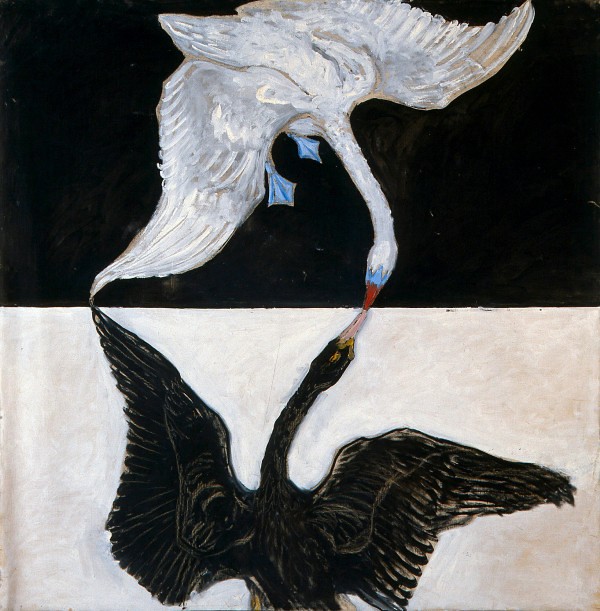
The blog, Dangerous Harvests, which focuses on writings about Zen Buddhism, yoga, social justice and politics, the arts, and life in general, notes “while we continue to struggle with defining what it is that we mean by Buddhism in the West, perhaps it would be valuable to go further back in time, and consider more thoroughly how the planks we stand on today were laid. And if nothing else, there is plenty of beautiful artwork and interesting life stories just waiting to be re-discovered.” Using the work of Hilma af Klint (1862-1944) as an example, he writes:

Swedish artist Hilma af Klint was, like many others of the period, influenced primarily by the teachings of Theosophy. In a lot of ways, theosophy paved the way for the New Age movement, especially with its emphasis on blending spiritual and religious teachings and focus on the evolution of consciousness. It's an interesting, if odd mixture of things, and certainly one can argue that Blavatsky and others cherry picked and culturally appropriated a myriad of traditions to suit their needs. However, it also can be viewed as the spirited, if overreaching reaction of spiritual people to a world that suddenly was becoming globally connected right before their eyes. We are in a similar period now, with the internet and other technology, making the gap between nations even smaller - and in the process, shaking up the entire way we - as humans - understand and interact.


Hilma af Klint

Thursday, March 3, 2011

Blavatsky and Count Witte


HPB’s first cousin, Count Sergei Witte, will get a new evaluation based on his written memoirs. Oxford University Press will be publishing Francis W. Wcislo’s study, Tales of Imperial Russia: The Life and Times of Sergei Witte, 1849-1915, which is scheduled for release in May. Subjecting Witte’s reminiscences to historical record, Wcislo writes: “Truth be told, his memoirs are, quite simply stories: narrated tales and remembered impressions of a life in imperial Russia that allow the historian access to the cultural values, human identities, and patterns of life experience, which constituted its rhythms.…Indeed, Blavatsky’s story was the very first genuine ‘tale’ he told. All of Witte’s narrative devices were here for the first time on display.”

The English version of Witte’s Memoirs, based on dictated material and translated by Abraham Yarmolinsky in 1921, and by Sidney Harcave in 1990, has been a prime source of information on Blavatsky’s life in Russia. His mother, Katherine Witte (née Fadeeva), was the younger sister of HPB’s mother, and he spent part of his childhood living with his grandparents, as HPB had done.

What Witte knew of Blavatsky’s debut in the 1850s was mainly family lore, buttressed by both his belief she possessed ‘some sort of supernatural talent’ and his own few boyhood memories of her. In that sense he constructed Blavatsky. There was Blavatsky the orphan, raised by his grandparents after Elana Gan’s early death. Blavatsky was a young, harried woman, married off to a much older civil official in Armenia when she was 17, who within months had fled home to her grandparents. She was the runaway. Returned to Tiflis, Blavatsky was dispatched to her father in Russia, but, arriving in the Black Sea steamship depot of Poti, she ‘took the scent (sniukhat’sia)’ of an English steamship captain and sailed off with him to the capital city of the Ottomans, which Witte in Greek and Slavic fashion called Constantinople. There she became…a circus bareback rider, lover of the European opera bass Mitrovitch, companion of a London man on business in America, follower of the mid-century’s ‘greatest spiritualist’, concert pianist and choirmaster of the Serbian king. This bewildering array of indentities for the illicit woman was very much Witte’s concoction. They all bore little facsimile to the historical record, none more so than his own memory of a chastened Blavatsky, returned in 1860 to Tiflis and a respectable life, when Witte would have been 12.

“Women’s History Month Celebrates Female Cannabis Connoisseurs”


This was the headline posted by the magazine Cannabis Culture on March 1. The feature, listing, among others, H.P. Blavatsky, directs the reader to the site, Very Important Potheads, which has profiles of several female connoisseurs mentioned, including an entry on Blavatsky, which can be read here. The source for its information of her indulging is A.L. Rawson, “a close friend of Blavatsky for over forty years,” who wrote:

“She had tried hasheesh in Cairo with success, and she again indulged in it in this city under the care of myself and Dr. Edward Sutton Smith, who had had a large experience with the drug among his patients at Mount Lebanon, Syria. She said: ‘Hasheesh multiplies one’s life a thousandfold. My experiences are as real as if they were ordinary events of actual life. Ah! I have the explanation. It is a recollection of my former existences, my previous incarnations. It is a wonderful drug and it clears up profound mystery.’”

VIP comments: The modern day Theosophical Society denies hashish had any great influence on Blavatsky’s life, admitting she may have experimented with it in her youth, but that is about the extent of it. But a number of well known authors, such as Benjamin Walker and the much respected English writer Colin Wilson, thought her use of cannabis was relevant enough to have commented on it. The Theosophists point to a couple of negative comments towards hashish Blavatsky made near the end of her life when her health had deteriorated from chain-smoking cigarettes, and found herself unhappily surrounded by scandal. Many people have blamed a substance for their own personal downfall, and marijuana makes just as good a scapegoat as any. As many of us have experienced, few seem as self-righteous as the reformed addict. The Theosophists also challenge the legitimacy of A.L. Rawson, suggesting his claims are suspect. The fact is that A.L. Rawson was one of a few life-long friends Blavatsky had, and she herself attested to the validity of his character.

The “validity” of Rawson’s character has been the subject of a good piece of investigative journalism by John Patrick Deveney, “The Travels of H.P. Blavatsky and the Chronology of Albert Leighton Rawson: an unsatisfying investigation into H.P.B.’s whereabouts in the early 1850s,” published in the October 2004 issue of Theosophical History. Simply put: Rawson = suspect.

Who Was Fred S. Ellmore?


The blog, Me, Myself, and I, has an interesting sidelight on the identity of someone mentioned in Lucifer, September 1890. In the section, “Queries and Answers,” in that issue, Mme. Blavatsky was asked to comment on an account in the August 8, 1890, Chicago Tribune where Fred S. Ellmore, a young Chicagoan back from India, described some feats of legerdemain, including the Indian rope trick and the instantaneous growth of a mango tree, witnessed at Gaya. Even though the paper later revealed that the account was a fabrication by one of their writers, the story of the Indian rope trick took on a life of its own. As the blog points out:

Even H. P. Blavatsky was lured into it (September, 1890) never getting the “Fred S. Ellmore” punch line.
You see, Fred S. Ellmore was a pseudonym used by John Elbert Wilkie.
The inside joke being:
Fred S. Ellmore ==> Fred Sell More.

John Elbert Wilkie (1860–1934), an American journalist, later went on to head of the United States Secret Service from 1898 to 1911.