Sunday, January 30, 2011

Reginald Machell


The American Center for Craft, Creativity and Design posts some background on Theosophist Reginald Machell not used in the book Makers: A History of American Studio Craft by Janet Koplos and Bruce Metcalf published by the University of North Carolina Press, July 2010. Machell, who was born in England in 1854, died at Point Loma, California, in 1927. He met Blavatsky in London and did some of the designs at the Theosophical Hall that was opened in 1890 at the Headquarters at 19 Avenue Road. In 1900 he moved to Point Loma, California, where he arrived on December 28. “At Point Loma, he carved chairs, screens and stools decorated with forms reminiscent of Art Nouveau, Celtic interlace, Gothic tracery, flames and wings. They are wonderfully inventive, completely unlike any other furniture made in America.”

The post, which can be read here, explains: Theosophy was created in 1875 by a charismatic Russian occultist named Helena Blavatsky (1831-1891), who melded elements of Hinduism, Buddhism and sheer invention into a quasi-religion that drew numerous followers around the turn of the century. Blavatsky held that anyone could attain a higher level of consciousness, and that this spiritual work was a matter of direct experience, not requiring the mediation of any church. Theosophy attracted people troubled by the materialism of the age and hungry for a more personal experience of the spiritual.

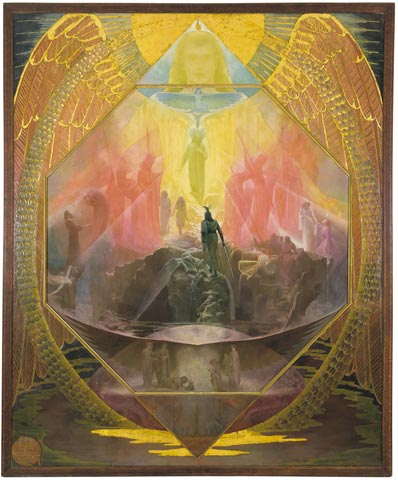
Machell is best remembered for his painting, “The Path” (6’2” x 7’5”), which is housed at the headquarters of the Theosophical Society, in Pasadena, California. The frame, made by him, is another example of his ornate woodwork. Reginald Machell’s output as part of the Theosophical experience is documented in Bruce Kamerling’s essay, “Theosophy and Symbolist Art: the Point Loma Art School” in The Journal of San Diego History, Volume 26, Number 4, Fall 1980, which can be seen here.


Thursday, January 27, 2011

At the Feet of the Master


The Spring Program for the Krotona School of Theosophy in Ojai, California, offers a four-part series with Michael Gomes titled “HPB Teaches: A Comprehensive Guide to the Writings of Helena P Blavatsky.” The sessions will go from May 3–6, Tuesday–Friday, 10AM–noon. The course description says:

Although the name of Helena Petrovna Blavatsky is familiar to many, the content of her literary output, aside from her main works, remains less known. Michael Gomes, editor of a number of her works, offers an intensive seminar for those who want a more complete overview of her writings. Using his anthology, HPB Teaches, as the sourcebook, participants will have the opportunity of accessing HPB’s writings firsthand with him.

Over the past few years Michael Gomes has been giving a weeklong seminar somewhere on an aspect of HPB’s work. In 2010 it was at the Springbrook Centre in the Australian rainforest, in 2009 it was in Budapest, Hungary, and in 2008 with Joscelyn Godwin in Venice, Italy. This year it will be in Ojai, California. His long expertise—forty years of research and a quarter century of publishing—makes him a reliable guide for understanding Helena Petrovna Blavatsky, and no doubt what he has to say on the subject will be of interest.

Other presenters for the Krotona Spring session include the physicist, Amit Goswami, and his wife, Uma Krishnamurthy, who will give a performance of Bharatanatyam, classical Indian dance, and the Gnostic scholar, Stephan A Hoeller, who will have a program on “C.G. Jung’s Red Book and Alchemy.” Information about registering for the course can be found here.

Sunday, January 23, 2011

Centenary of ‘Concerning the Spiritual in Art’


Wassily Kandinsky II by Jacques Moitoret

The journal Theology from the Society for Promoting Christian Knowledge carries an article in its January-February 2011 issue on “A theology of abstraction: Wassily Kandinsky’s ‘Concerning the Spiritual in Art’” by Charles Pickstone, St Laurence Church, Catford, England. It looks at Kandinsky’s Concerning the Spiritual in Art, “the first theoretical work on abstract art, and now a standard work for all 20th- and even 21st-century artists,” which will be having its centenary this year.

The book was hugely influential both at the time and subsequently. The Modern
Movement was about to sweep Europe in all the arts (Pierrot Lunaire 1912, Ulysses
1918, The Waste Land 1922), and many artists and general readers, puzzled by the
“missing subject” of abstract art, found Kandinsky’s rationale persuasive.

The influences shaping Kandinsky’s ideas about the spiritual in art are noted: Russian Orthodox Church; the works of Schopenhauer, whose World as Will and Representation was particularly noted in this work; “Madame Blavatsky’s colour mysticism in her theosophical writings (an unlikely but now well-documented influence)”; and Goethe’s writings on the philosophy of colour, from a hundred years before. The source for the information of Blavatsky's influence comes from Sixten Ringbom’s 1986 study “Transcending the Visible: The Generation of the Abstract Pioneers” in Maurice Tuchman, ed., The Spiritual in Art: Abstract Painting 1890–1985 (Los Angeles County Museum of Art, 1986), which good as it is, a lot has been done since then, as the Legacies of Theosophy Conference at the University of Sydney and the recent Colloquium in Liverpool on “Enchanting Modernity: Theosophy and the Arts in the Making of Early Twentieth-Century Culture” show.

According to the author: “Kandinsky realised that all effects are relative. Each rhythmic stroke, each adjacent colour, is part of a dynamic system of pulsing interaction.” How Blavatskian.

Thursday, January 20, 2011

Natacha Rambova


The blog French Sampler reminds us of the spiritual interests of Natacha Rambova (1897-1966) in their post of January 18. Born Winifred Shaughnessy she changed her name to Natacha Rambova at the age of seventeen and began a career in ballet, involved with a number of leading Russian performers at the time. Her interest in design led her to Hollywood where she met Rudolph Valentino, whom she married in 1922.

Both Rambova and Valentino were Spiritualists. She had been interested in ancient religions since her teen years. She believed in reincarnation and psychic powers. Later in life she became an Egyptologist, an author on astrology, and a follower of Madame Blavatsky and George Gurdjieff.

Rambova's interest in the metaphysical grew during the 1940s, with her supporting the Bollingen Foundation, which she believed help her see a past life in Egypt. She published various articles on healing and astrology during this time. Eventually she helped decipher ancient scarabs and tomb inscriptions which led her to edit a series of publications titled, "Egyptian Texts and Religious Representations". She also conducted classes in her apartment about myths, symbolism, and comparative religion.

Her collection of Egyptian antiquities were donated to the Utah Museum of Fine Arts. She willed a huge collection of Nepali and Lamaistic art to the Philadelphia Museum of Art. Rambova's ashes were scattered in Arizona.

The text, taken from Wikipedia, and augmented with an interesting selection of photographs, can be read here.

Thursday, January 13, 2011

“What ever happened to the occult?”


The blog Twittering Machines raises the question: “What ever happened to the occult?” in a post of January 7, 2011. In trying to answer it, the writer talks about the experience of his obtaining an original 1877 edition of the two volumes of Blavatsky’s Isis Unveiled at a now-defunct bookshop in New York City.

I found my copy of Isis Unveiled at the Isaac Mendoza Book Company among the impossibly narrow aisles and overcrowded, crooked shelves and I found it while knee-deep in Yeats, paint and while working as an IT consultant on Wall Street. Surely a case of some sort of divine intervention. You can see that on the front free endpaper of my copy of Isis Unveiled the former owner Charles H Macy has written “Not to be loaned on account of opinions expressed herein.” Obviously this is a dangerous book. Oddly, RH Macy (yes that Macy) passed away in 1877 the same year this book was published. Coincidence? (that’s how the occult works, isn’t it?)

The full account is here.


The New Metaphysicals


The Journal of the American Academy of Religion posts an online advance of a review by Ann W. Duncan of The New Metaphysicals: Spirituality and the American Religious Imagination by Courtney Bender (The University of Chicago Press, 2010. 272 pages. $25.00). The book “profiles the new generation of Metaphysicals in Cambridge [Massachusetts] and, in keeping with Bender’s previous work, examines their translation of conviction into practice and constructed society.”

The “Long Shadows” cast by the early advocates of metaphysical religion of early Cambridge such as William James, Ralph Waldo Emerson, Helena Blavatsky, and Edgar Casey remain a palpable presence for both the author and her subjects as Bender questions how individuals become “spiritual but not religious” (3)…. In this way, the New Metaphysicals are in keeping with their historical predecessors such as Helena Blavatsky who eliminated the possibility of regression from the Hindu concept of samsara. As Blavatsky and others demonstrate, “mystical practice not only rewrites local worlds and relations. It also engages and critiques the authorities, experiences, and narratives used by others to lay claim to the past and future” (152).

The rest of the review can be read here.

Russian Women Travelers in Central Asia and India


The Russian Review for January 2011 carries a study by Katya Hokanson on “Russian Women Travelers in Central Asia and India.” She points out that as the Russian Empire enlarged to the East and to the South in the nineteenth century it brought an increase in travel writing which gained popularity with the Russian reading public.

The perspectives of three women writer-travelers of the mid to late nineteenth century, Elena Blavatskaia, Elena Apreleva, and Iuliia Golovnina, provide insight into the techniques of presenting the expansion of the empire to the public and assimilating the new territories and ideologies as part of Russian history, geography and identity. Women writers themselves were on the increase in the nineteenth century, with many establishing careers as writers and journalists, yet they were still much less common than male writers and their perspectives are valuable, since their subject position could rarely be taken for granted. They had to explain why they were writing, or resort to male pseudonyms, and the maneuvers they employed indicated how they constructed their identity as European Russians first and foremost.