Thursday, May 23, 2013

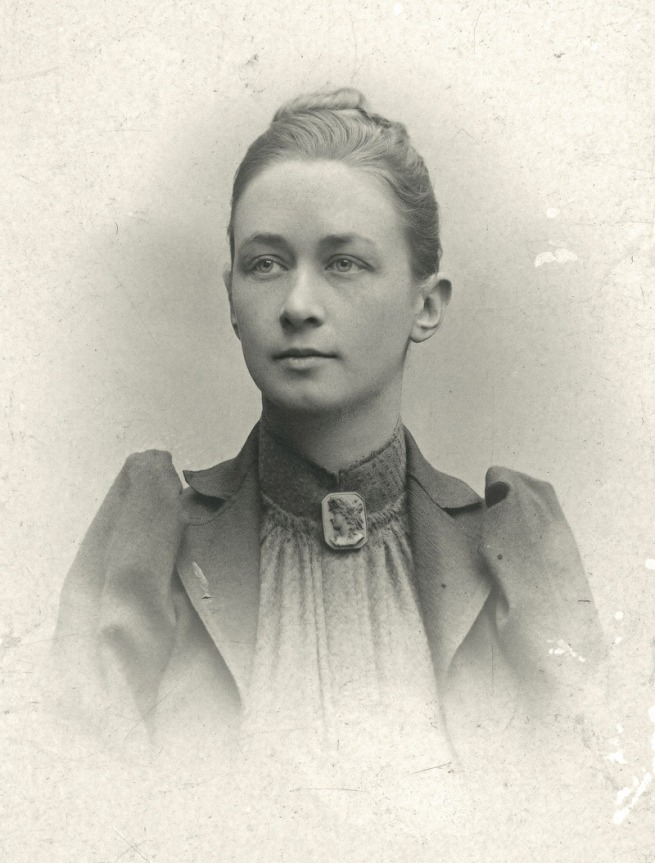
Hilma af Klint


We are OCA, the art, design, photography, music, textiles and writing blog maintained by staff and tutors of the Open College of the Arts in England, reports on the experience of viewing the exhibition dedicated to the Swedish artist Hilma af Klint (1862–1944) at the Moderna Museet in Stockholm, Sweden. The exhibition is huge—over 1,000 paintings and works on paper supported by decades of notebooks (around 124 in total), explaining the processes and thoughts behind the works. It is also significant. It is the first time that many of these pieces will be on view. According to the catalog: “Although she exhibited her early, representational works, she refused to show her abstract paintings during her lifetime. In her will, she stipulated that these groundbreaking works must not be shown publicly until 20 years after her death. She was convinced that only then would the world be fully and completely ready to understand their significance.” Apparently, the time is now right. The reviewer adds:

Hilma af Klint’s complex and articulate paintings have been revered as being possibly the first non-objective works to be made in the early 1900’s; two years prior to the Russian born artist Wassily Kandinsky who has historically been accredited with the accolade of being the first purely abstract painter.

Negotiating around the masculine domain of art making by working through automatism and spiritual séances, Hilma af Klint appears to allow herself more freedom and reverence by working directly through ‘High Masters’ in their masculine form; through instructed spiritualist experience. Influenced heavily by the infamous Madame Blavatsky, the co-founder of ‘The Theosophical Society’ and writer of ‘The Secret Doctrine’, af Klint’s ‘High Masters’ guided her hand in an attempt to gain spiritual knowledge of the self and of the universe.

This causes one of the commentators to post: Madame Blatavsky, despite being accused of faking some of the effects at her seances seems to have inspired some great art. (!)


The Hilma af Klint exhibition at Moderna Museet in Stockholm closes on May 26. For those unable to see it, the Venice Biennale will have five of her paintings in the Central Pavilion from June to November this year. Notice of the exhibition is given in the Blavatsky News post of January 24, 2013.

Thursday, May 16, 2013

Blavatsky’s Subtle Body


Geoffrey Samuel, Director of the Research Group on the Body, Health and Religion at Cardiff University, has added a new book to his numerous studies on Tibetan religious culture. Professor Samuel has edited with Jay Johnston, Religion and the Subtle Body in Asia and the West: Between Mind and Body. Fourteen academic writers, including Samuel and Johnston, contribute on subjects related to their area of expertise. At 296 pages, the book published by Routledge UK, sells for £90.00 / $155.00 USD. Chapters are grouped into four sections detailing (1) Subtle Bodies in China and India; (2) Subtle Bodies in the Tibetan Tradition; (3) Subtle Bodies in Europe and Islam; and, of course, (4) Subtle Bodies and Modernity. Dr. Johnston of the Department of Studies in Religion, University of Sydney, who introduces part 4 of the book, notes Blavatsky’s contribution to the notion of a “Subtle Body”:

Blavatsky’s text in her multi-volumed tomes Isis Unveiled and The Secret Doctrine draw together scientific aspirations (and nomenclature), Eastern religious ideas (adapted and changed), and Hermetic ideas and astrology. Core to the complex cosmology of ‘planes if existence’ and ‘root races’ was the subtle body.

She writes that “In Theosophical narratives, the subtle body comprises seven layers or sheaths, each interpenetrating and exceeding the other,” which is only partially correct. In Blavatsky’s schema the consciousness of the individual has seven aspects, often referred to as principles, rarely as bodies. Drawing from Blavatsky and Alice Bailey, a brief attempt on defining how these bodies function leads quickly into an outline of the contribution of C.W. Leadbeater and Alice Bailey and later writers who were influenced by them. Unfortunately the book includes no chapter on Blavatsky and her influential ideas on the subject, though a detailed literature exists.

The pioneering 1919 work by Blavatsky’s secretary, G. R. S. Mead, The Doctrine of the Subtle Body in Western Tradition: An Outline of What the Philosophers Thought and Christians Taught on the Subject, is referenced.

Sunday, May 12, 2013

Blavatsky News


*  Another indicator of Blavatsky’s permeation in contemporary culture can be seen in the following reference to her in a sports column. Yahoo Sports, under the headline, “Behind the Box Score, where the playoffs have begun and the Clippers are up one,” carried a report on the Boston Celtics and New York Knicks which ended with New York winning 85, Boston 78.

And because this was a Boston/New York game, both teams regressed in a way that would make Helena Blavatsky proud. 


Occult Notebook of Xul Solar
*  An exhibition in New York on the Argentine artist Xul Solar (Oscar Agustín Alejandro Schulz Solari), “Xul Solar and Jorge Luis Borges: The Art of Friendship,” looks at “the intellectual exchange between the mystic artist Xul Solar (1887-1963) and the writer Jorge Luis Borges (1899-1985.) The Art of Friendship focuses on the fraternal dialogue and collaborations between Solar and Borges, the most singular cultural figures in Buenos Aires in the twentieth century who contributed to the philosophical and aesthetic renewal in Argentina in the 1920s by cultivating a form of ‘fluid nationalism’.”  The program notes: 

Xul Solar lived in Europe between the years 1918 and 1923 and during this time he studied the works of H. P. Blavatsky, Emanuel Swedenborg and William Blake among others who informed his interest in theosophy, spiritualism and astrology.

The exhibition at the Americas Society in New York runs from April 18 to July 20, 2013.


* A number of recent programs in the U.S. relating to the Blavatsky are worth noting: Paul Ivey’s presentation on his book Radiance from Halcyon, a history of the Temple of the People, at the historic IOOF Hall at 128 Bridge Street in Arroyo Grande, California, on Friday May 3. Michael Gomes’s weeklong seminar at the Krotona School of Theosophy, May 7 to 10, on Blavatsky’s Esoteric Instructions, commemorating the 125 anniversary of her School. David and Nancy Reigle will be giving a three day workshop, June 14-16, 2013, on the Book of Dzyan at the Ozark Theosophical Camp and Education Center in Sulphur Springs, Arkansas. The Reigles have spent the past 30 years looking into the origins of the Book of Dzyan and have contributed enormously to our understanding of the matter. Their program can be seen here.

Sunday, April 7, 2013

Blavatsky News


*  “Enlightenment in the Cemetery: The Adams Memorial and Buddhism in 19th Century America,” an April 4 post at the New York Historical Society blog, makes a connection between the Adams Memorial in Washington, D.C. and H.P. Blavatsky. “Commissioned on the [1885] death of his wife by Henry Adams, it is one of the most widely celebrated pieces of American funerary art.” The writer believes that “the memorial’s principal inspiration is Buddhist,” and that “the Adams Memorial’s symbolism is a reflection of America’s burgeoning relationship with Buddhism in the late nineteenth century.”

The 1891 bronze allegorical sculpture by Augustus Saint-Gaudens of a shrouded figure seated against a granite block is the tomb’s most prominent feature.  As a possible source for the image, Buddhist devotional art is suggested, for Adams had directed Saint-Gaudens to consider it in his design. The piece also suggests that “the memorial’s central figure is the Kannon, a buddhist deity and ‘the bodhisattva of infinite compassion and mercy ’.”

Interestingly, while the memorial he commissioned is such an outstanding symbol of the emerging popularity of Buddhism in this period, Adams never “took refuge” or formally converted in contrast to many well-known contemporaries such as William Sturgis Bigelow, Henry Steel Olcott and Madame Blavatsky.


*  Professor Paul Ivey will be presenting a slide lecture based on his new book, Radiance from Halcyon, A Utopian Experiment in Religion and Science, at the New York Theosophical Society, 242 East 53rd Street, New York, NY 10022, on Sunday, April 14, at 2 PM.

Starting in the 1890s in Syracuse, New York, with the rising of the Temple of the People, a splinter group of the theosophical movement, Ivey will trace the group's development in California. “In addition to an intriguing account of how a little-known utopian religious community profoundly influenced modern science, Ivey offers a wide-ranging cultural history, encompassing Theosophy, novel healing modalities, esoteric architecture, Native American concepts of community, socialist utopias, and innovative modern music.”

Paul Ivey is associate professor of art history at the University of Arizona, and is the author of Prayers in Stone: Christian Science Architecture in the United States, 1894–1930.

Blavatskiana


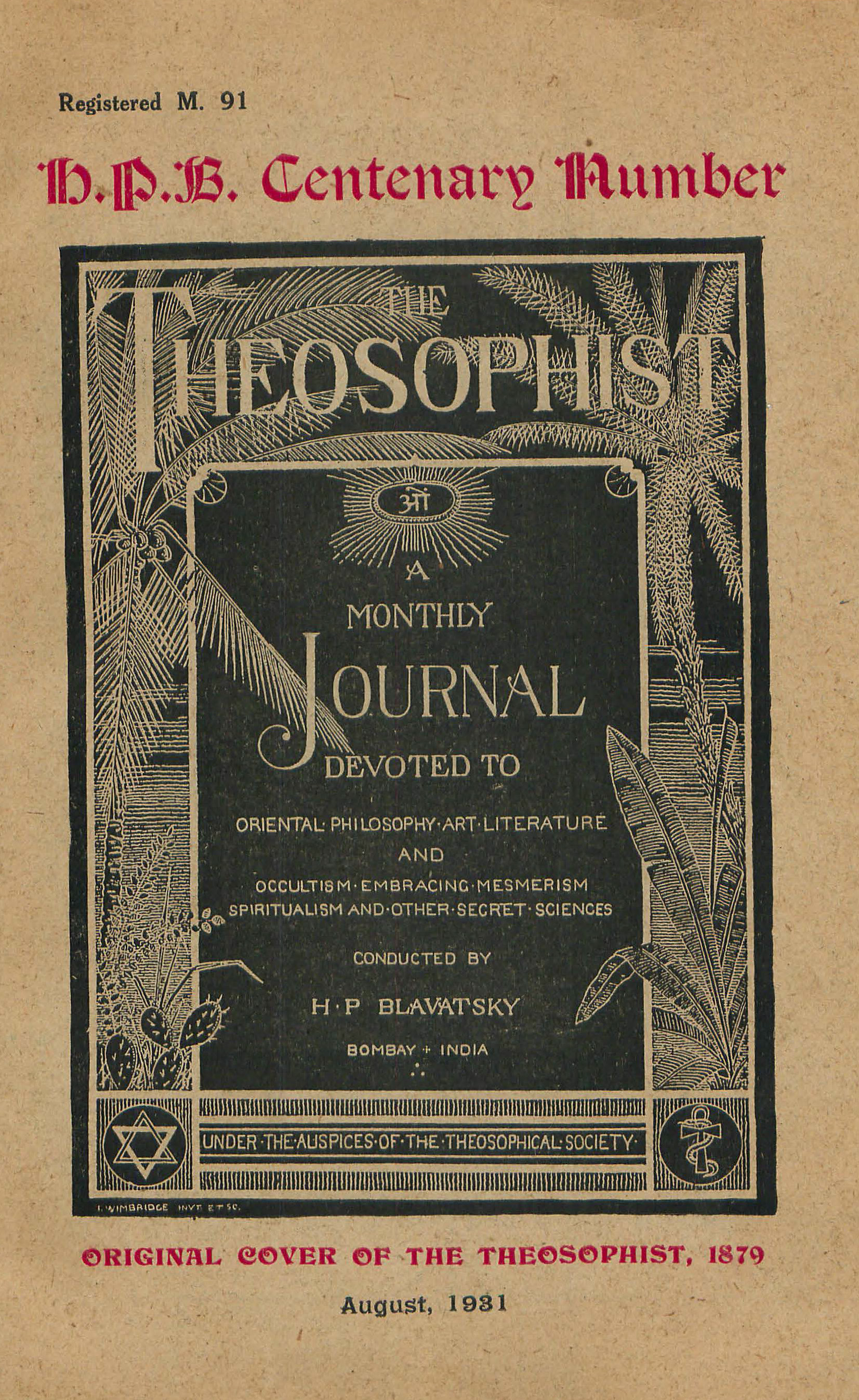
Marc Demarest has uploaded the August 1931 issue of The Theosophist, published from Adyar, India. The issue was dedicated the birth centenary of the founder of the journal, H. P. Blavatsky, and its extended use of facsimiles, illustration, rare photographs, and unpublished writings from Blavatsky’s pen, produced a memorial issue that has not been rivaled. It is truly a unique piece of Blavatskiana.

 It is available at IAPSOP (International Association For The Preservation Of Spiritualist And Occult Periodicals), “a US-based non-profit organization focused on the digital preservation of Spiritualist and occult periodicals Our all-volunteer staff digitizes, indexes and makes available free-of-charge these periodicals, in our Archive, for use by students and researchers. Each periodical is curated by a staff member, accessible to students and researchers when they need assistance, or have questions.” A list of the projected journals can be viewed here.

Sunday, March 24, 2013

Blavatsky in Village India


The blog, Even Monks Carry Cell Phones, carries a March 22 post on “The Theosophy of Indian Villages,” detailing the level of saturation Theosophy has achieved in rural India based on encountering it there. The writer tells of her experience:  

“There’s a Theosophy meeting at 9:30 every Sunday in this town.”
 
 “In this small village?” I implore amazed. 

 
“Theosophy?!” I stare at him in disbelief. 

 
 “It’s been going on for 50 years,” is his reply.  

 
Attending a meeting of the Theosophical Society, she says: 

 
I’m greeted by one of the younger members and sit in the short meeting. Shelves of hundred year old books in English and Gujarati line the back. I take a few books, again, astounded that this small village in Gujarat has been so greatly influenced by the teachings of a Russian and Britisher [sic] (Madame Blavatsky and Henry Steel Olcott respectively). 

 
 Chuni Kaka tells me that Vasant Dada used to come to the meetings back when they used to discuss Sarvodaya (upliftment of all). The Theosophy meetings were used to encourage moral empowerment, economic self-sufficiency, and proper utilization of resources. 

 
Chuni Kaka and Prachi at Khardoli Theosophical Society

Thursday, March 21, 2013

Blavatsky News


* A March 18 post on Michael D. Sellers’ blog The John Carter Files essays Blavatsky’s influence on Edgar Rice Burroughs (1875–1950), creator of Tarzan and the Mars adventurer John Carter.

There are also strong, albeit disputed, indications that Burroughs had at least been exposed to the writings of the theosophists, particular Helena Blavatsky, whose various postulations regarding lost races and cultures including Atlantis and Lemuria included a variety of features that would match a great deal of what Burroughs would offer when he conjured Barsoom.  Fritz Leiber wrote of this in his 1959 treatise “Burroughs and the Sword of Theosophy”, as did L. Sprague de Camp.

Neither Leiber nor de Camp postulates that Burroughs actually believed what Blavatsky was peddling; only that the correlations are too great to be mere coincidence, suggesting that Burroughs found in them a certain attractive mythic force which he harnessed to his “pure entertainment” purposes.


* Ronnie Pontiac continues his delineation of the development of the interest in Plato in America outside of academia in the March 19 issue of Newtopia Magazine. In this installment he details the life and passions of Missouri classical scholar, Thomas Moore Johnson (1851-1919) of Osceola, in “Thomas Johnson: Platonism Meets Sex Magic on the Prairie.”

Johnson visited fellow Neoplatonic enthusiast Alexander Wilder in New Jersey in 1876, during the time Wilder was working with Madame Blavatsky on Isis Unveiled.  Wilder became one of Johnson’s steadiest supporters, his most important collaborator, and Wilder contributed many essays and two translations to The Platonist.  On his trip east Johnson also stopped in Concord to meet with Alcott and his daughter, Louisa, the famous author who had published Little Women seven years earlier.

Part of Johnson’s library survives at the University of Missouri’s Thomas Moore Johnson Collection of Philosophy. “The collection spans the centuries from the ancient Greeks to the nineteenth century philosophers, but the emphasis is on the classical authors, augmented by modern philosophy and criticism. The medieval Christian philosophers are also represented. Since the collector was a Platonist, it is expected that the collection of works of Plato and the critical works would be large.” The catalog is available online.